Four-Season vs. Three-Season: What the Distinction Actually Means
These terms get used loosely, so here's a plain explanation. A four-season sunroom is a fully conditioned addition, insulated walls, thermal-break framing, low-E glass, and a connection to your home's HVAC system or a dedicated mini-split. It's comfortable year-round in Wilmington, including the peak of summer when outdoor temperatures run into the upper 90s with high humidity, and on the occasional cold winter days when temperatures drop into the low 30s at night.
A three-season room is not fully conditioned. It's enclosed with glass or panel systems that block wind and rain, but the thermal performance isn't at the level of a four-season room. In Wilmington's climate, "three seasons" roughly translates to October through May, maybe into June on cooler days. July and August in an unconditioned glass enclosure in coastal NC are genuinely uncomfortable. If year-round usability is your goal, a four-season sunroom is the right answer.
For three-season rooms specifically, see our Three-Season Rooms page, which covers EZE-Breeze and similar panel systems in more detail.
Updated June 2026.
Impact Glass for Coastal NC
Properties in New Hanover County and surrounding coastal areas fall within the NC wind-borne debris region. This affects what glazing is acceptable for permitted additions. Standard single-pane or non-impact glass doesn't meet code in this zone. You need either impact-rated glass or standard glass with an approved storm shutter system.
For sunrooms, impact-rated insulated glass units are the standard choice. These use a laminated glass layer, similar to automotive windshield glass, that holds together if broken by debris rather than shattering into the room. For a four-season sunroom, the glass is also low-E coated to reduce solar heat gain and keep cooling costs manageable.
Impact glass costs more than standard glass and the premium varies by unit size and specification. For a coastal NC property, it's not optional if you want the structure to pass inspection. We design sunrooms with impact-rated glazing as standard for all projects in the high-wind zone.
HVAC Sizing for Wilmington's Humidity Load
Sizing HVAC for a sunroom in Wilmington is different from sizing it for a sunroom in a drier climate. The humidity load here is significant. Wilmington's average relative humidity stays above 75 percent for most of the year. A glass-walled room with significant solar exposure that's attached to a moist outdoor environment needs more dehumidification capacity than a typical interior room of the same square footage.
We coordinate with HVAC contractors on sunroom projects to make sure the system specified for the space is sized for the actual heat gain through the glass and the latent load from moisture. An undersized system that runs constantly and still can't bring humidity below 60 percent is a problem you don't want. A mini-split system with both cooling and dehumidification capability is often the best fit for sunrooms that aren't tied into the main home's existing ductwork.
The structural side of a sunroom project also requires permits through New Hanover County Building Inspections. Because a sunroom is a conditioned addition, the permit scope typically includes the building permit plus electrical, and HVAC permits if new equipment is being installed. We pull the building permit and coordinate with your licensed HVAC and electrical subs for the mechanical work.
How Sunrooms Differ from Screened Porches for the Wilmington Climate
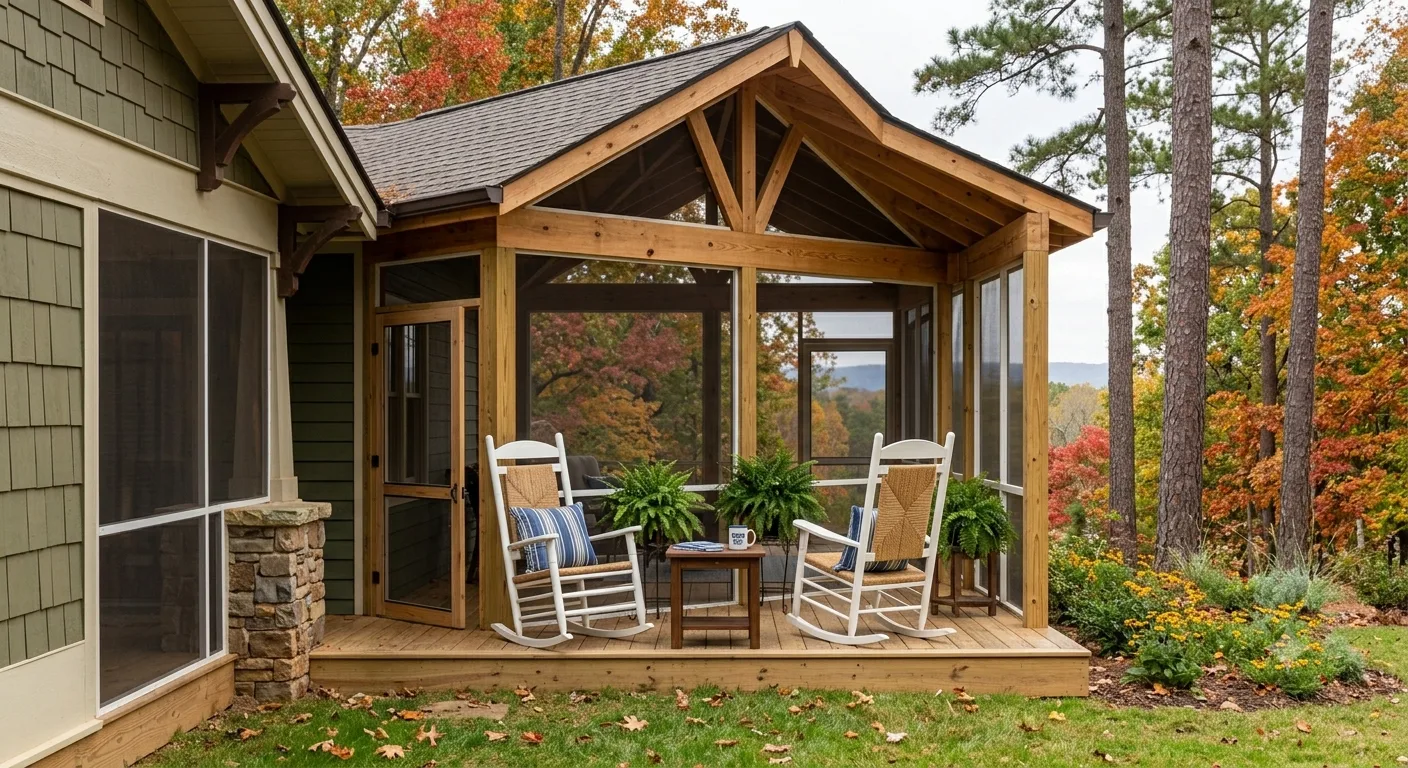
A screened porch in Wilmington is an outdoor space with bug and weather protection. Air flows through the screen. Temperatures inside track the outside air closely. On a hot humid July day, a screened porch without a ceiling fan running is still hot and humid. That's appropriate for what it is, and a lot of people genuinely enjoy that connection to the outdoor air and the sounds of the neighborhood or yard.
A sunroom is an interior space that happens to have a lot of glass. You're inside, with climate control, but surrounded by views and natural light. The experience is fundamentally different. You're not going to hear rain on the screen panels or get a cross breeze. But you can use the space in July and August, or on a cold January evening, in a way you can't use a screened porch.
The cost difference is also significant. A basic screened porch in Wilmington might run $10,000-$20,000. A four-season sunroom with impact glass and its own HVAC typically runs $40,000-$80,000 or more depending on size and specification. We build both, and we can help you think through which one fits what you're actually trying to accomplish. Call us or submit the estimate form to start that conversation. We serve Wilmington, Leland, Hampstead, Wrightsville Beach, Carolina Beach, and the surrounding Cape Fear Coast communities.